P22页开始,罗列了很多大画家。无机客在导读中就提到,上海今年夏天的美国当代艺术展上就有个别惊人呈现。
Thomas Cole (born England, 1801-1848)
这位风景画巨匠的作品很多,是我本人所不喜欢的那种风格,但无论如何是我本人无法学到的一门精湛技艺。无论是书中插页中模糊的黑白《河套》,还是节日气氛的美国新建筑,都充满了一种巨细无靡的虚假感——恰是画得太好而导致的某种失真感。当然,一己之言,决无意冒犯大家。
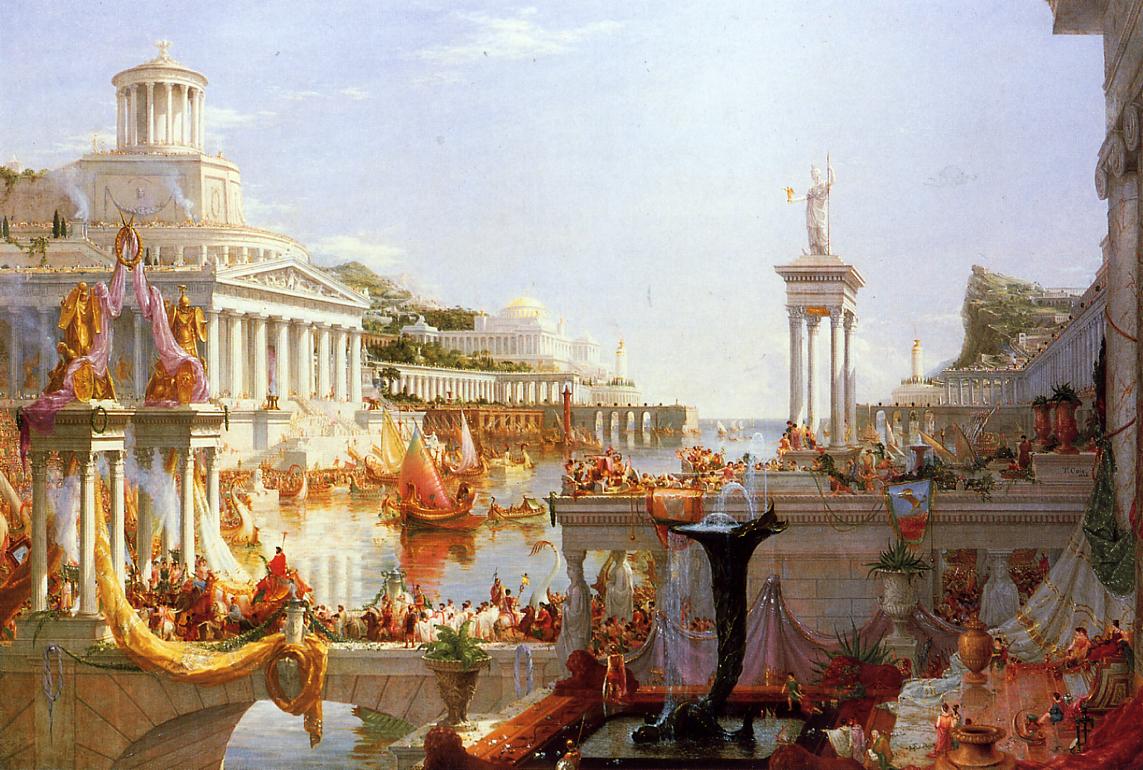
The Course of the Empire - Consummation of the Empire (Oil, 1836)
This is the third in Thomas Cole's "Course of the Empire" series. (Be sure to start at the first painting so that you can see how the sun rises and moves through the sky. The mountain in the background remains throughout, but in the foreground, there are considerable changes.)
Here are the links to each of the paintings: First Painting - Second - Third - Fourth - Last
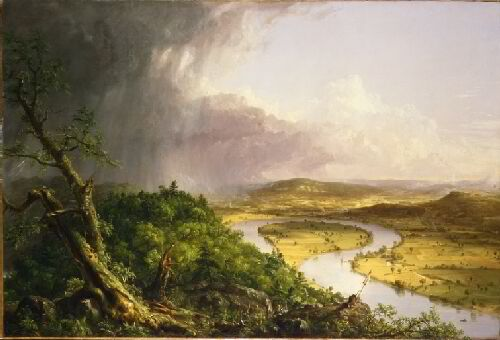
书中插画即这幅《河套》
View from Mount Holyoke Northampton Massachusetts after a Thunderstorm(1836)Oil on canvas; (130.8 x 193 cm)
Description:
Long known as "The Oxbow," this work is a masterpiece of American landscape painting, laden with possible interpretations. In the midst of painting "The Course of Empire" (New-York Historical Society), Cole mentioned in a letter dated March 2, 1836, to his patron Luman Reed that he was executing a large version of this subject expressly for exhibition and sale. The picture was shown at the National Academy of Design in 1836 as "View from Mount Holyoke, Northampton, Massachusetts, after a Thunderstorm." Cole`s interest in the subject probably dates from his 1829?2 trip to Europe, during which he made an exact tracing of the view published in Basil Hall`s "Forty Etchings Made with the Camera Lucida in North America in 1827 and 1828." Hall criticized Americans` inattentiveness to their scenery, and Cole responded with a landscape that lauds the uniqueness of America by encompassing "a union of the picturesque, the sublime, and the magnificent." Although often ambiguous about the subjugation of the land, here the artist juxtaposes untamed wilderness and pastoral settlement to emphasize the possibilities of the national landscape, pointing to the future prospect of the American nation. Cole`s unequivocal construction and composition of the scene, charged with moral significance, is reinforced by his depiction of himself in the middle distance, perched on a promontory painting the Oxbow. He is an American producing American art, in communion with American scenery. There are both sketchbook drawings with annotations and related oil sketches of this subject. Many other artists copied or imitated the painting.
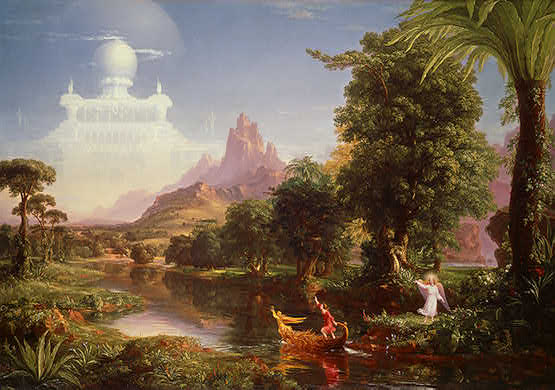
The Voyage of Life
尽管我不太喜欢这种宗教格调的绘画,但这段表述还蛮有意思:Thomas Cole prepared detailed explanatory texts for each painting in this four-part series. The following are Cole's own words about this painting: A stream is seen issuing from a deep cavern, in the side of a craggy and precipitous mountain, whose summit is hidden in clouds. From out the cave glides a Boat, whose golden prow and sides are sculptured into figures of the Hours: steered by an Angelic Form, and laden with buds and flowers, it bears a laughing Infant, the Voyager whose varied course the artist has attempted to delineate. On either hand the banks of the stream are clothed in luxuriant herbage and flowers. The rising sun bathes the mountains and the flowery banks in rosy light.
The dark cavern is emblematic of our earthly origin, and the mysterious Past. The Boat, composed of Figures of the Hours, images the thought, which we are borne on the hours down the Stream of Life. The Boat identifies the subject in each picture. The rosy light of the morning, the luxuriant flowers and plants, are emblems of the joyousness of early life. The close banks, and the limited scope of the scene, indicate the narrow experience of Childhood, and the nature of its pleasures and desires. The Egyptian Lotus in the foreground of the picture is symbolical of Human Life. Joyousness and wonder are the characteristic emotions of childhood.
Cole's renowned four-part series traces the journey of an archetypal hero along the "River of Life." Confidently assuming control of his destiny and oblivious to the dangers that await him, the voyager boldly strives to reach an aerial castle. As the traveler approaches his goal, the ever-more-turbulent stream deviates from its course and relentlessly carries him toward the next picture in the series, where nature's fury, evil demons, and self-doubt will threaten his very existence. Only pray er, Cole suggests, can save the voyager from a dark and tragic fate.
From the innocence of childhood, to the flush of youthful overconfidence, through the trials and tribulations of middle age, to the hero's triumphant salvation, The Voyage of Life seems intrinsically linked to the Christian doctrine of death and resurrection.
Trouble is characteristic of the period of Manhood. In Childhood there is no cankering care; in Youth no despairing thought. It is only when experience has taught us the realities of the world, that we lift from our eyes the golden veil of early life; that we feel deep and abiding sorrow; and in the picture, the gloomy, eclipse-like tone, the conflicting elements, the trees riven by tempest, are the allegory; and the Ocean, dimly seen, figures the end of life, to which the voyager is now approaching. The demon forms are the temptations that beset men in their direst trouble. The upward and imploring look of the voyager, shows his dependence on God, and that faith saves him from the destruction that seems inevitable.
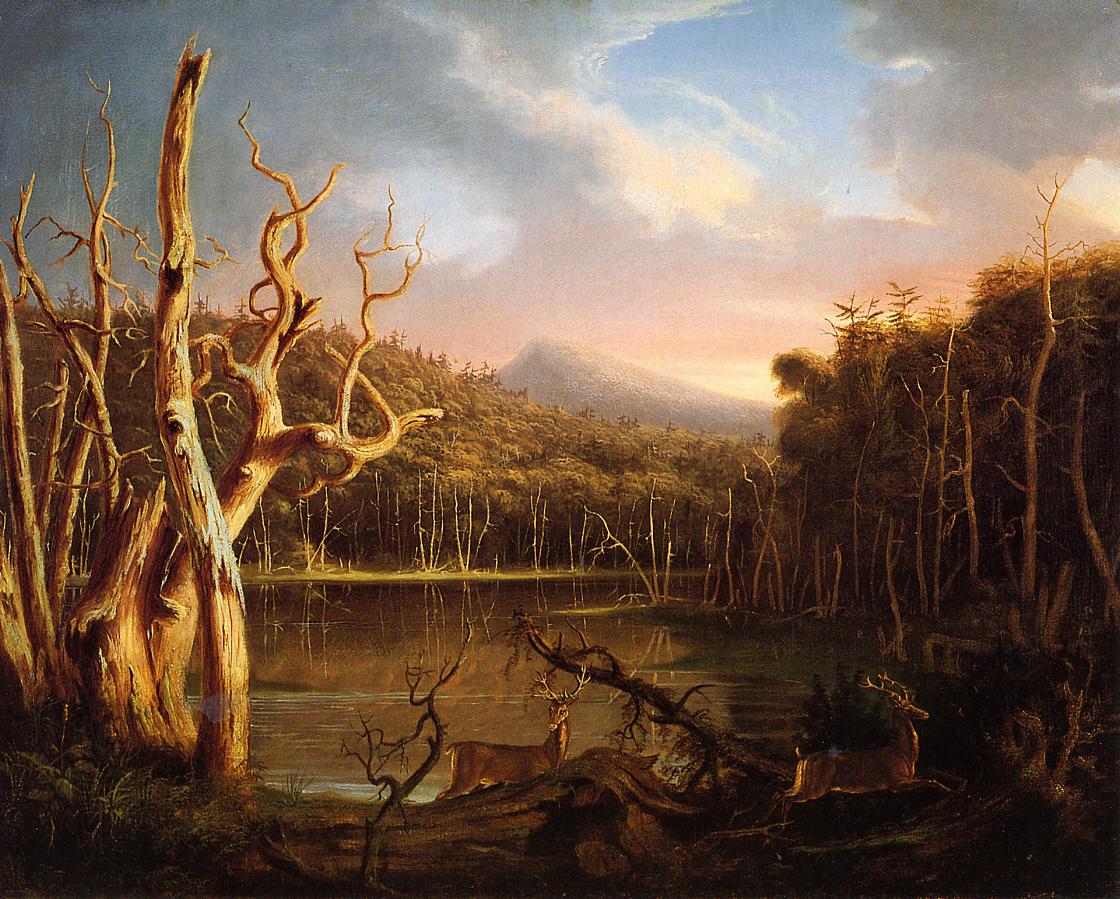
Lake with Dead Trees, 1825
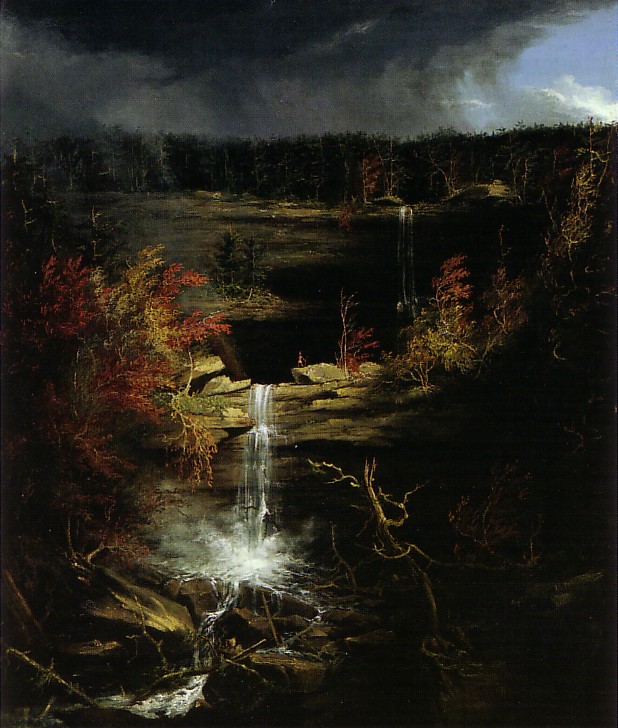
Falls of Kaaterskill (1826)
Oil on canvas 109.2 x 91.4 cm
Warner Collection, Tuscaloosa, Alabama
其实这两幅我很喜欢的。显然,画家面对人为景观和自然景观的状态很不一样,就像萨金特画肖像和画风景时截然不同一样。书中到了结局处,皮安波也自称,画下的风景都像是自画像。
John Constable (1776-1837)
John Constable was born in East Bergholt, Suffolk, England on 11th June 1776. Initially his father, Golding Constable wanted young John to join him is his prosperous corn business. By 1799 however it was obvious that John loved nothing more than drawing, so he was given an allowance to study at the Royal Academy in London. The art world was slow to recognize his talents. Landscapes were not considered very important in his day, so he had to produce a few portraits for his income. He would often spend his Summers in East Anglia, making sketches ready for them to be transformed into his beautiful works when he returned to his home in London. During these early years he created such works as Boatbuilding near Flatford Mill (1814-15) which can be seen in the Victoria and Albert Museum in London.
In 1819 he moved to Hampstead Heath on the outskirts of London. By this time his father had died, so he was more financially secure. He was now producing his best work, including The Haywain in 1821. The work was based on many sketches he had produced, many of which still survive. In 1824 The Haywain was exhibited in Paris, where it won a gold medal. The painting caused a stir amongst the French art critics, who were astonished by its freshness. In his later years he lectured, still trying to popularize landscape painting, but he died in 1837 with none of the fame he now has.
也是为不得不为了养活自己画点肖像的画家,毕生心血和才华都在乡村风景中浓缩,对河流、天空、树木爱得非常详尽。去世时也没啥大名气。我们的主人公皮安波的祖父据说就是画这样的风景画的。
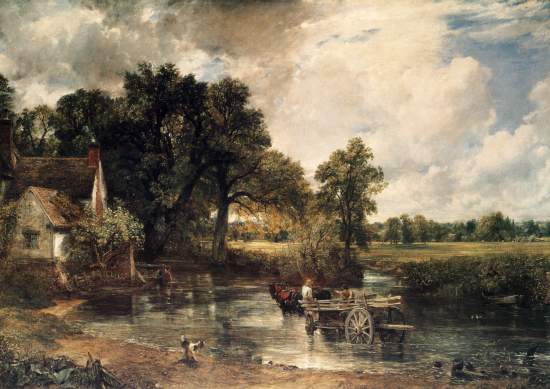
The Haywain 1821
这幅画,我确信,如果能站在原画前欣赏,一定会被柔和的笔触所打动的!
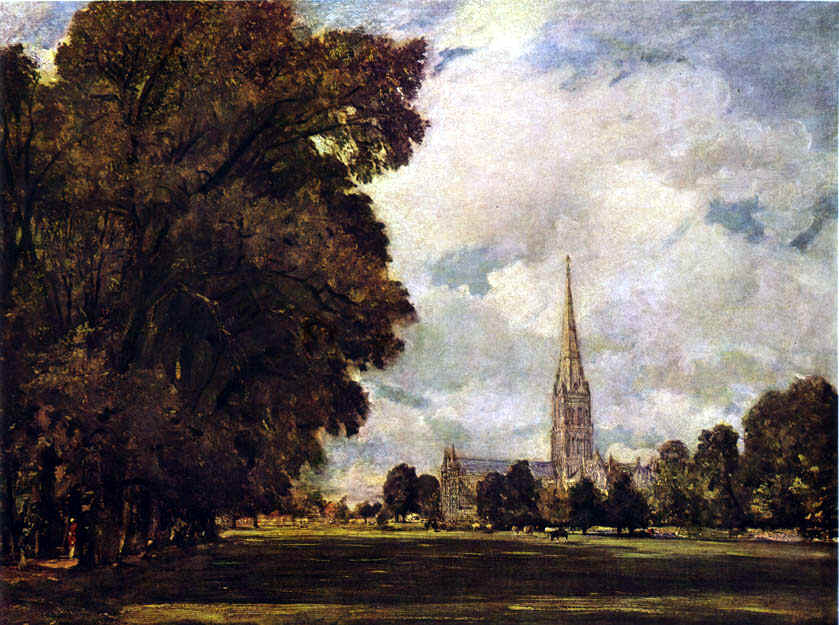
Salisbury Cathedral From Lower Marsh Close
这是书中所选用的画。查下来才知道,这一系列就有多福作品。
诸如
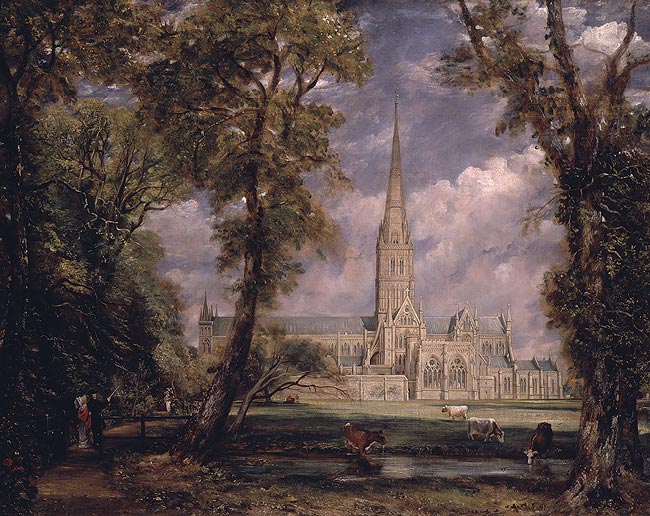
Salisbury Cathedral from the Bishop's Grounds, ca. 1825
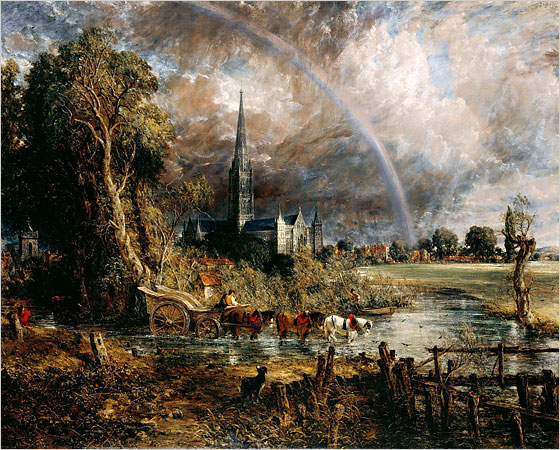
Salisbury Cathedral From the Meadows” (1831).
Wivenhoe Park, Essex, (1816)
这幅画的细部极其讲究,请看http://www.essex.ac.uk/constable/details.htm#dam
Stonehenge 1836, Watercolour
这是画家晚年的作品,和上面的细腻风景相比,真是迥然不同啊! |


 发表于 2008-4-4 18:57:36
 发表于 2008-4-8 22:40:44