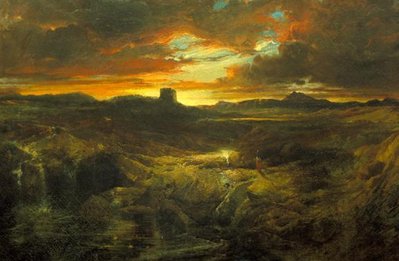
Childe Roland To The Dark Tower Came
by Robert Browning
(1812-1889)
I.
My first thought was, he lied in every word,
That hoary cripple, with malicious eye
Askance to watch the working of his lie
On mine, and mouth scarce able to afford
Suppression of the glee, that pursed and scored
Its edge, at one more victim gained thereby.
II.
What else should he be set for, with his staff?
What, save to waylay with his lies, ensnare
All travellers who might find him posted there,
And ask the road? I guessed what skull-like laugh
Would break, what crutch 'gin write my epitaph
For pastime in the dusty thoroughfare,
III.
If at his counsel I should turn aside
Into that ominous tract which, all agree,
Hides the Dark Tower. Yet acquiescingly
I did turn as he pointed: neither pride
Nor hope rekindling at the end descried,
So much as gladness that some end might be.
IV.
For, what with my whole world-wide wandering,
What with my search drawn out thro' years, my hope
Dwindled into a ghost not fit to cope
With that obstreperous joy success would bring,
I hardly tried now to rebuke the spring
My heart made, finding failure in its scope.
V.
As when a sick man very near to death
Seems dead indeed, and feels begin and end
The tears and takes the farewell of each friend,
And hears one bid the other go, draw breath
Freelier outside, (``since all is o'er,'' he saith,
``And the blow falIen no grieving can amend;'')
VI.
While some discuss if near the other graves
Be room enough for this, and when a day
Suits best for carrying the corpse away,
With care about the banners, scarves and staves:
And still the man hears all, and only craves
He may not shame such tender love and stay.
VII.
Thus, I had so long suffered in this quest,
Heard failure prophesied so oft, been writ
So many times among ``The Band''---to wit,
The knights who to the Dark Tower's search addressed
Their steps---that just to fail as they, seemed best,
And all the doubt was now---should I be fit?
VIII.
So, quiet as despair, I turned from him,
That hateful cripple, out of his highway
Into the path he pointed. All the day
Had been a dreary one at best, and dim
Was settling to its close, yet shot one grim
Red leer to see the plain catch its estray.
IX.
For mark! no sooner was I fairly found
Pledged to the plain, after a pace or two,
Than, pausing to throw backward a last view
O'er the safe road, 'twas gone; grey plain all round:
Nothing but plain to the horizon's bound.
I might go on; nought else remained to do.
X.
So, on I went. I think I never saw
Such starved ignoble nature; nothing throve:
For flowers---as well expect a cedar grove!
But cockle, spurge, according to their law
Might propagate their kind, with none to awe,
You'd think; a burr had been a treasure-trove.
XI.
No! penury, inertness and grimace,
In some strange sort, were the land's portion. ``See
``Or shut your eyes,'' said nature peevishly,
``It nothing skills: I cannot help my case:
``'Tis the Last judgment's fire must cure this place,
``Calcine its clods and set my prisoners free.''
XII.
If there pushed any ragged thistle-stalk
Above its mates, the head was chopped; the bents
Were jealous else. What made those holes and rents
In the dock's harsh swarth leaves, bruised as to baulk
All hope of greenness?'tis a brute must walk
Pashing their life out, with a brute's intents.
XIII.
As for the grass, it grew as scant as hair
In leprosy; thin dry blades pricked the mud
Which underneath looked kneaded up with blood.
One stiff blind horse, his every bone a-stare,
Stood stupefied, however he came there:
Thrust out past service from the devil's stud!
XIV.
Alive? he might be dead for aught I know,
With that red gaunt and colloped neck a-strain,
And shut eyes underneath the rusty mane;
Seldom went such grotesqueness with such woe;
I never saw a brute I hated so;
He must be wicked to deserve such pain.
XV.
I shut my eyes and turned them on my heart.
As a man calls for wine before he fights,
I asked one draught of earlier, happier sights,
Ere fitly I could hope to play my part.
Think first, fight afterwards---the soldier's art:
One taste of the old time sets all to rights.
XVI.
Not it! I fancied Cuthbert's reddening face
Beneath its garniture of curly gold,
Dear fellow, till I almost felt him fold
An arm in mine to fix me to the place,
That way he used. Alas, one night's disgrace!
Out went my heart's new fire and left it cold.
XVII.
Giles then, the soul of honour---there he stands
Frank as ten years ago when knighted first.
What honest man should dare (he said) he durst.
Good---but the scene shifts---faugh! what hangman hands
Pin to his breast a parchment? His own bands
Read it. Poor traitor, spit upon and curst!
XVIII.
Better this present than a past like that;
Back therefore to my darkening path again!
No sound, no sight as far as eye could strain.
Will the night send a howlet or a bat?
I asked: when something on the dismal flat
Came to arrest my thoughts and change their train.
XIX.
A sudden little river crossed my path
As unexpected as a serpent comes.
No sluggish tide congenial to the glooms;
This, as it frothed by, might have been a bath
For the fiend's glowing hoof---to see the wrath
Of its black eddy bespate with flakes and spumes.
XX.
So petty yet so spiteful! All along,
Low scrubby alders kneeled down over it;
Drenched willows flung them headlong in a fit
Of route despair, a suicidal throng:
The river which had done them all the wrong,
Whate'er that was, rolled by, deterred no whit.
XXI.
Which, while I forded,---good saints, how I feared
To set my foot upon a dead man's cheek,
Each step, or feel the spear I thrust to seek
For hollows, tangled in his hair or beard!
---It may have been a water-rat I speared,
But, ugh! it sounded like a baby's shriek.
XXII.
Glad was I when I reached the other bank.
Now for a better country. Vain presage!
Who were the strugglers, what war did they wage,
Whose savage trample thus could pad the dank
Soil to a plash? Toads in a poisoned tank,
Or wild cats in a red-hot iron cage---
XXIII.
The fight must so have seemed in that fell cirque.
What penned them there, with all the plain to choose?
No foot-print leading to that horrid mews,
None out of it. Mad brewage set to work
Their brains, no doubt, like galley-slaves the Turk
Pits for his pastime, Christians against Jews.
XXIV.
And more than that---a furlong on---why, there!
What bad use was that engine for, that wheel,
Or brake, not wheel---that harrow fit to reel
Men's bodies out like silk? with all the air
Of Tophet's tool, on earth left unaware,
Or brought to sharpen its rusty teeth of steel.
XXV.
Then came a bit of stubbed ground, once a wood,
Next a marsh, it would seem, and now mere earth
Desperate and done with; (so a fool finds mirth,
Makes a thing and then mars it, till his mood
Changes and off he goes!) within a rood---
Bog, clay and rubble, sand and stark black dearth.
XXVI.
Now blotches rankling, coloured gay and grim,
Now patches where some leanness of the soil's
Broke into moss or substances like boils;
Then came some palsied oak, a cleft in him
Like a distorted mouth that splits its rim
Gaping at death, and dies while it recoils.
XXVII.
And just as far as ever from the end!
Nought in the distance but the evening, nought
To point my footstep further! At the thought,
great black bird, Apollyon's bosom-friend,
Sailed past, nor beat his wide wing dragon-penned
That brushed my cap---perchance the guide I sought.
XXVIII.
For, looking up, aware I somehow grew,
'Spite of the dusk, the plain had given place
All round to mountains---with such name to grace
Mere ugly heights and heaps now stolen in view.
How thus they had surprised me,---solve it, you!
How to get from them was no clearer case.
XXIX.
Yet half I seemed to recognize some trick
Of mischief happened to me, God knows when---
In a bad dream perhaps. Here ended, then,
Progress this way. When, in the very nick
Of giving up, one time more, came a click
As when a trap shuts---you're inside the den!
XXX.
Burningly it came on me all at once,
This was the place! those two hills on the right,
Crouched like two bulls locked horn in horn in fight;
While to the left, a tall scalped mountain... Dunce,
Dotard, a-dozing at the very nonce,
After a life spent training for the sight!
XXXI.
What in the midst lay but the Tower itself?
The round squat turret, blind as the fool's heart,
Built of brown stone, without a counter-part
In the whole world. The tempest's mocking elf
Points to the shipman thus the unseen shelf
He strikes on, only when the timbers start.
XXXII.
Not see? because of night perhaps?---why, day
Came back again for that! before it left,
The dying sunset kindled through a cleft:
The hills, like giants at a hunting, lay,
Chin upon hand, to see the game at bay,---
``Now stab and end the creature---to the heft!''
XXXIII.
Not hear? when noise was everywhere! it tolled
Increasing like a bell. Names in my ears
Of all the lost adventurers my peers,---
How such a one was strong, and such was bold,
And such was fortunate, yet, each of old
Lost, lost! one moment knelled the woe of years.
XXXIV.
There they stood, ranged along the hill-sides, met
To view the last of me, a living frame
For one more picture! in a sheet of flame
I saw them and I knew them all. And yet
Dauntless the slug-horn to my lips I set,
And blew. ``Childe Roland to the Dark Tower came.''
《黑暗塔》的书名来自布朗宁的长篇叙事诗《罗兰少爷前往黑暗塔》。主题是托肯恩的寻觅和魔法,背景则是利昂的莽荒西部——苍凉世界,劫后文明,黑暗之塔,时空交错。《黑暗塔》汲取了西方骑士文学、美国西部电影、现代科幻文体的营养,也加入埃及神话、日本武士道、“披头士”、星球大战,蜘蛛侠等内容,甚至将他本人在先前作品中的人物一并拉来客串,以造成时光交错的效果。
以下节选自上海三联出版社的《与死者协商》一书
我一直觉得勃朗宁Robert Browning(1812—1889)英国维多利亚时期代表诗人之一。那首恶梦般的诗《罗兰骑士来到暗塔》(Childe Roland to the Dark Tower Came)很耐人寻味。这首诗的叙事者是罗兰骑士,正背负使命追寻某样事物,诗中并未说明追寻的对象为何,不过看来不像是圣杯。通常在追寻的使命中,会有某个值得辛苦的目标——要找到什么,可以得到什么——途中也会有各式各样的困难必须克服,罗兰骑士亦是如此。但他每踏出一步,这番追寻便变得更加无望、更加阴惨。一名老人奚落他——在追寻的故事中,这向来是不祥之兆——随着他行经之处愈来愈荒芜、愈来愈像沼泽,他的勇气也逐渐消退。最后,在他最料想不到的时候,突然就来到了暗塔,他发现自己困在一个陷阱里:四周景物朝他逼近,没有出路;更有甚者,他被鬼魂团团围住,全是那些在他之前出发进行同一项使命而失败的人,正等着他加入他们的行列,于是他明白自己这番追寻是注定要失败的。
诗中告诉我们,暗塔是栋充满威胁感的建筑,四平八稳,难以穿透,全世界仅此一座,塔上挂着一种叫做蛞蝓号角的东西。这是个讨厌的乐器,勃朗宁大概是从查特顿译注:Thomas Chatterton(17521770)英国诗人。的作品中借来此词,查特顿用这个词指“小号”,而我想勃朗宁喜欢这名字意味的恶心声响,因为跟诗里的整体景致很搭配。总之,你必须吹响蛞蝓号角,向住在暗塔里某个人或某个东西挑战:读者得到的强烈印象是某种怪物。
我觉得罗兰骑士的暗塔就像乔治·奥威尔的小说《一九八四》中,温斯顿·史密斯的101号房:对进房的每一个人而言,里面有着他最恐惧的事物。让我们假设罗兰骑士是作家,也就是罗伯特·勃朗宁的替身,他追寻的事物是一首还没写出的诗,叫做《罗兰骑士来到暗塔》,暗塔里的怪物就是罗兰骑士自己,是他写诗的这一面。我的证据如下:首先,勃朗宁是一口气写完这首诗,它不是一项计划,而可以说是一股沛然莫之能御的冲动,这种冲动通常来自写作本身的最深处。其次,本诗的灵感来自莎士比亚剧作中的三句,出于《李尔王》废屋炉台旁的发疯场景:
罗兰骑士来到暗塔:
只听他说道——“嘿,喝,我闻到不列颠人的鲜血味。”4
我们小时候都听过,这就是“杰克与魔豆”故事里巨人说的话。但在莎士比亚笔下,说这句话的却是罗兰骑士自己。因此,对读到这几句、而后写出这首诗的勃朗宁来说,罗兰骑士就是他自己要面对的巨人。但他同时也是杀死巨人的人。所以,他便是自己的化身,要杀死自己。 |


 发表于 2007-9-30 22:59:16